How to Assess Your Dog's Quality of Life: The HHHHHMM Scale Explained
- Jade Lane

- May 28
- 4 min read

Observing the decline of a senior dog brings a unique, heavy sense of dread. It often triggers a very specific, late-night Google search rabbit hole: how to tell if my dog is dying.
You monitor each breath, every pause before they stand, and every meal they leave unfinished. You constantly wonder: Is today a good day? Is it a bad one? And beneath it all lies the toughest question of all: How many comfortable days do they actually have left?
The problem is that most pet parents are trying to answer these massive life-and-death questions with nothing but a search engine and a dysregulated nervous system—and under chronic stress, both are highly unreliable narrators.
Thankfully, veterinary medicine has a reliable clinical framework for answering this question. Most owners have just never been introduced to it
What Vets Actually Use to Assess Dog Quality of Life
The tool is called the HHHHHMM Scale. It was developed by Dr. Alice Villalobos, a pioneering veterinary oncologist and leader in pet palliative care, and published in her seminal book Canine and Feline Geriatric Oncology. Since then, it has been widely adopted by veterinary hospice teams globally as the gold standard for quality-of-life assessment.
The acronym stands for seven distinct health and behavioral domains:
Hurt: Is your dog's pain being managed? Are they able to breathe comfortably? Pain in dogs often presents quietly as social withdrawal, unexpected posture changes, or a tense brow.
Hunger: Is your dog eating enough to maintain their body condition? Chronic loss of appetite is one of the earliest signals of declining wellbeing.
Hydration: Is your dog getting enough fluids? Dehydration can be checked at home by monitoring skin elasticity (turgor) or the moisture of their gums.
Hygiene: Can your dog be kept clean and dry? This looks at whether wounds, skin conditions, or urinary incontinence are being managed without causing them physical distress.
Happiness: Does your dog still respond to things they used to enjoy? Do they seek connection with the family or show interest in their environment?
Mobility: Can your dog move enough to satisfy basic needs and engage with life? The inability to change positions without help or to reposition to avoid pressure sores is a major metric.
More Good Days Than Bad: When you look at the last week as a whole, are the comfortable, peaceful days winning?
In a clinical setting, each domain is traditionally scored from 1 to 10. While a total score above 35 indicates an acceptable quality of life, the scale isn't just about a final number—it is a framework for forcing your brain to notice subtle shifts you might otherwise overlook or emotionally avoid.
Why a Single PDF Assessment Isn't Enough
One of the reasons quality-of-life conversations are so agonizing is that senior and sick dogs fluctuate constantly. A dog navigating cancer, kidney failure, heart disease, or severe osteoarthritis rarely has the same day twice. Pain levels spike and recede. Appetite drops after a treatment and returns. A week of great mobility can be instantly followed by a sudden setback.
Veterinary research on chronic pain confirms this extreme daily variability. A 2022 study published in Frontiers in Veterinary Science found that owner-reported pain scores for dogs with osteoarthritis varied significantly day-to-day. Factors like daily activity level, sudden weather shifts, and medication timing all contributed to major, observable differences in baseline behavior.
This is why a single quality-of-life assessment—the kind of static PDF checklist you print out once from a random website—fails. It gives you a temporary snapshot, not a true picture. It tells you about today's panic, but it cannot tell you how your dog is actually coping over time.
The Clinical Case for Data Tracking Over Time
When you log the exact same indicators over consecutive days and weeks, the emotional noise clears and real patterns emerge. You start to notice that the bad days cluster around specific triggers, or that the good days are becoming genuinely rarer. Conversely, it can also show you that your pet's health is far more stable than your caregiving anxiety was telling you.
This kind of longitudinal observation is standard practice in human palliative care, and it is vital for senior pets. Caregiver perception is significantly more accurate when it is grounded in recorded data rather than retrospective memory.
Human memory is deeply vulnerable to recency bias, particularly when a caregiver is operating under chronic stress. A 2019 review published in the Journal of Veterinary Internal Medicine noted that owners of dogs with terminal illnesses frequently reported severe difficulty accurately recalling their dog's recent quality of life, especially when asked to compare changes across multiple weeks.
Your memory naturally skews toward the most recent experience or the most emotionally charged, panic-filled moment. Tracking gives your brain a factual anchor.





Remove the guesswork from palliative care
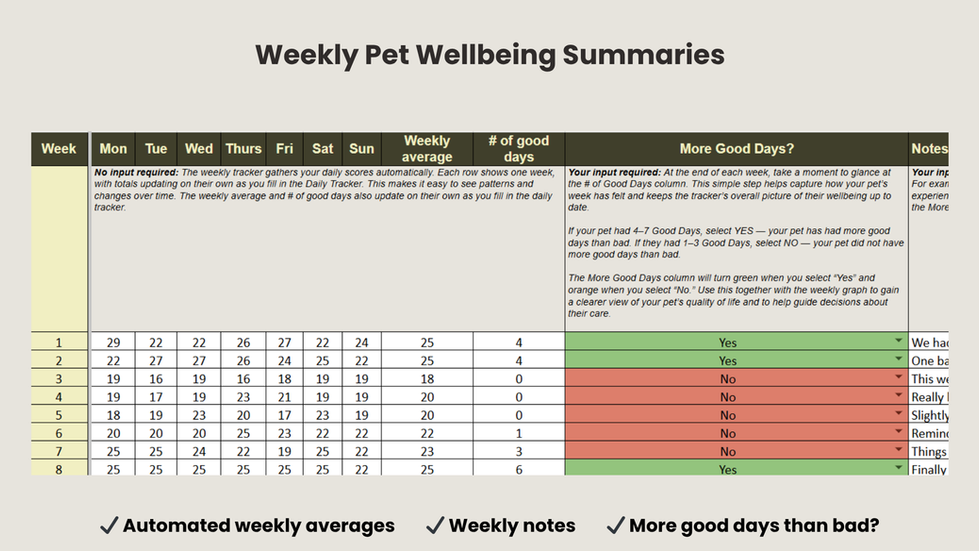
We built the More Good Days Tracker specifically to solve this exact problem. Designed around the trusted HHHHHMM framework, our interactive digital spreadsheet allows you to log each domain in under two minutes a day.
It handles the math and visual trends automatically, transforming your daily care notes into a clean, visual chart. Instead of guessing, you will have concrete, longitudinal data to bring directly to your next veterinary consultation.
🔗 Take control of your caregiving journey. Explore the Spreadsheet Tracker & Companion 23-Page Guide Bundle on our Etsy Store ($30 AUD).


Comments